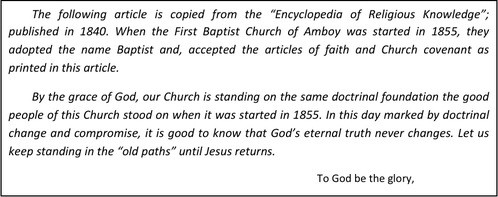
Baptists: A well-known denomination of Christians, distinguished by their simple adherence to the Scriptures, by their views of the spiritual constitution of the Christian church, and of the holy design, subjects and mode of baptism. In regard to this ordinance of Christ, “they have ever held,” says Mr. Benedict, their historian, “that a personal profession of faith, and an immersion in water are essential to baptism.” Some of their arguments for these opinions may be found under the article BAPTISM. In regard to the constitution of the Christian church, while they believe in the existence of a universal or catholic church, composed of the whole body of believers in Christ in all nations and ages, they think that the Christian Church, properly so called, was not visibly organized in the family of Abraham, nor in the wilderness of Sinai; by the ministry of Christ himself and of his apostles; and that it was then constituted of such, and such only, as made a credible profession of repentance from sin, and faith in the Savior. All others they consider to be constitutionally excluded. That the primitive churches were uniformly organized on these principles; that they embraced only visible saints, and were essentially voluntary compacts of piety, virtue, and brotherly love, they think perfectly plain from the New Testament. This new and beautiful organization, so unlike all establishments founded on national principles, they believe to be the kingdom of God, foretold by the prophet Daniel, and announced by John the Baptist as at hand. Dan. 2:44. And in the days of those kings shall the God of heaven set up a kingdom, which shall never be destroyed; and the kingdom shall not be left to other people, but it shall break in pieces and consume all these kingdoms, and it shall stand forever. Matt.3:2, 4:17. et passim.
Hence the Baptists reject the baptism of infants, and national church establishments, as obvious innovations, incompatible with the spiritual purity of the visible church of Christ. hence they distinguish between the covenant of grace in the Messiah, and covenant of circumcision; which the Pedo-baptists consider as one, though twenty-four hundred years elapsed between them. Gen 15: Gen. 17: Gal. 3: Hence also they reject all claims of the civil magistrate to any but a civil jurisdiction; though willing and peaceable subjects to civil authority, where the rights of conscience are not involved. Hence, in every age, their strong attachment to liberty; especially to religious liberty, whose principles they were the first to proclaim, and the first also to exemplify. Their principles have subjected them to persecution from age to age, and to such principles they have counted it a glory to be martyrs. Though their own blood has flowed freely, they have never shed the blood of others. Indeed, civil persecution of any kind, on their principles, is impossible. And to them was allowed the happiness of establishing in this country, in 1636, a code of laws, “in which,” says Judge Story, “we read for the first time since Christianity ascended the throne of the Caesars, the declaration that ‘conscience should be free, and men should not be punished for worshipping God in the way they were persuaded he required.’” This declaration Rhode Island has never departed from; and in it she has been since followed by all the United States. That wretched doctrine of the union of church and state, by which Christianity has been made the minister of every wrong, that boasted alliance on which so many encomiums have been lavished, they have ever regarded as a foul corruption, inconsistent with the very nature of that kingdom which is not of this world, destructive of the very purposes of the Christian church, and in effect “little more than a compact between the priest and the magistrate to betray the liberties of mankind; both civil and religious.” (Complete Works of Robert Hall, vol. ii. p. 22) Christians of these sentiments have existed in every age, and their number, as Mr. Benedict observes, has been larger than their friends generally imagine, or their opposers were ever willing to acknowledge. Among the most distinguished are Berengarius, Peter de Bruis, Henry, Arnold of Brescia, Lollard, Wickliffe, Tyndale, Menno, Dudith, Schyn, Tombes, Canne, Grantham, Milton, Bunyan, Delaune, Gale, Gill, Stennes, Booth, Butterworth, Gifford, Ryland, Carey, Marshman, Ward, Fuller, Hall, Foster, Gregory, Roger Williams, Backus, Stillman, Baldwin, Slaughton, Judson, & c.
Origin, History, &c. It has been asserted that the Baptists originated in Germany about the year 1522 at the beginning of the Reformation. It is true that no denomination of Protestants can trace the origin of its present name, farther back than about the time of the Reformation; and most of them have originated since that period. And it appears to be true that the name of Baptists, by which this people have since been known, was then first assumed, probably in opposition to that of Anabaptists, with which their enemies were continually reproaching them. (See ANABAPTISTS,) It is not, however, the history of a name, but the prevalence of principles, which is the just object of attention with the student of ecclesiastical history. The Baptists do not pretend that the primitive saints were called Baptists, but that all the primitive Christians were what would now be called by this name; and that there always has been a people on earth from the introduction of Christianity, who have held the leading sentiments by which they now are, and always have been, distinguished, is a point which they most firmly believe, and undertake to prove. In so doing, they attempt no wrong to any other denomination in Christendom. Their object, says Benedict, is not to show what is not true respecting others, but what is true concerning themselves. They do not deny that Episcopalians can find bishops, and the Presbyterians elders or presbyters, and the Methodists zeal, and the Quakers inward light, among the primitive Christians; neither do they doubt that the Congregationalists or Independents have good grounds for thinking that the apostolic churches were of their belief respecting church government. They only ask that terms should be properly explained. With most denominations they find something with which they can agree, and their hearts cleave in love to all who love the Lord Jesus Christ. And though compelled in some few points to differ from them all, it is only that they may with a pure conscience contend for the faith and keep the ordinances as they were delivered to the saints. Conscientious fidelity to Christ, and an ardent desire by every lawful means to win others to the same fidelity, they think, so far from deserving the name of sectarianism is the very essence of true Catholicism.
Innumerable volumes have been written under the title of Church History; but, after all, we know very little of the real church of Christ for many hundred years. We have very ample accounts of the Antichristian church, that false pretender, in unhallowed alliance with the kings of the earth, and drunken with the blood of the saints; but the history of the uncorrupted church, which maintained the word, worship, and ordinances of Christ, while all the world was wondering after the beast, is enveloped in the obscurity of that retreat which God prepared for her in the wilderness. It is astonishing to perceive how far even most Protestants are from acknowledging the whole truth on this subject. So deeply has the corrupt union of church and state, under which they still live, blinded their eyes, that Protestant writers still persist in styling the history of the papal power, for example, the history of the Christian church. Against this the Baptists protest. They believe, with the ancient Waldenses, the “the church of Rome is the whore of Babylon;” and “that only is the church of Christ, which hears the pure doctrine of Christ, and observes the ordinances instituted by him, in whatsoever place it exists.” (Waldensian Confession of the twelfth century.) Mosheim, with all his violent prejudices against the Baptists, in relating the history of the primitive church, has given a description which will not apply to his own church, the Lutheran, nor to any sect in Christendom except the Baptists. “The churches in those early times,” he observes, “were entirely independent, none of them subject to any foreign jurisdiction, but each one governed by its own rulers and laws. For though the churches founded by the apostles, had this particular deference shown them, that they were consulted in difficult and doubtful cases, yet they had no juridical authority, no sort of supremacy over the others, nor the least right to enact laws for them. A bishop during the first and second century was a person who had the care of one Christian assembly. In this assembly he acted not so much with the authority of a master, as with the zeal and diligence of a faithful servant. Baptism was administered in the first century without the public assemblies, in places appointed for that purpose, and was performed by the immersion of the whole body in water.” Mr. Robinson, after the most diligent research, not only confirms these statements of Mosheim, but says expressly, “All this time they were Baptist churches; and though all the fathers of the four first ages, down to Jerome were of Greece, Syria and Africa, and though they gave great numbers of histories of the baptism of adults, yet there is not one record of the baptism of a child till the year 370, when Galates, the dying son of the Arian emperor Valens, was baptized by the order of the monarch, who swore he would not be contradicted. The age of the prince is uncertain, and the assigning of his illness as the cause of his baptism, indicates clearly enough that infant baptism was not in practice.”
But the primitive churches in process of time became corrupted from the simplicity that is in Christ. This corruption, and the great apostasy to which it led, had been foretold in the Scriptures; (see article ANTICHRIST,) and even in the days of the apostles, the mystery of iniquity did already work. When in the third century, the discipline and morals of the principal churches became altogether relaxed, such as had the purity of the Redeemer’s kingdom at heart, after struggling in vain to resist the torrent of corruption, gradually separated themselves from a community which had become unworthy of the Christian name. Though these early Protestant dissenters were confounded with heretics by the prevailing party, which assumed the name of the Catholic church; yet it is certain, that their faith was scriptural and orthodox, and that among them we must look for the humble, pure, and persecuted church of Christ. Such, for example, were the Novatians at Rome; the Donatists in Africa; the AErians and Paulicians in Greece; the Carthari, or Puritans, of Germany; the Paterines of Italy; and the Waldenses of France, and other countries, a succession of whom continued up to the time of the Reformation. (see WALDENSES,)
For the history of the Baptists in Germany and Holland, see the article MENNONITES.
GREAT BRITAIN. The Baptists in England form one of three denominations of Protestant Dissenters. They separate from the Episcopal Establishment for the same reasons as their brethren of other denominations, with whom they are united, and from additional motives resulting from their particular tenets respecting baptism. The constitution of their churches and their mode of worship are congregational or independent; in the exercise of which they are protected, in common with other dissenters, by the act of toleration. Previous to this, they were liable to pains and penalties as Non-conformists, and often suffered for their peculiar sentiments as Baptists.
In the reign of Henry VIII, some of them were burnt, and others banished. In the reign of Elizabeth, they were subject to imprisonment; and in that of James, they fled into Holland. William Sawtre was the first who in this country suffered at the stake for his religious opinions, in 1401, and who was supposed to deny infant baptism; and Edward Wightman, a Baptist, of Burton-upon-Trent, was the last person that suffered this cruel kind of death in England: so that this denomination had the honor of both leading the way and bringing up the rear of all the martyrs who were burnt alive in England; besides which a great number of those who suffered death for religion in the two hundred intervening years were of the Baptist denomination.
The Baptists are distinguished into two denominations, which have but little communication with one another; namely, the Particular and the General Baptists.
THE PARTICULAR BAPTISTS are so denominated, from their embracing the Calvinistic system, which includes in it, as a leading article, the doctrine of particular redemption, though there are many among them who admit the universality of the atonement. The Calvinistic or Particular Baptists are by far the most numerous; their congregations in England and Wales, in 1832, amounting to above twelve hundred. They have four public academies for the education of young men for the ministry, at Bristol, Stepney, Bradford, and Abergavenny; and they have long enjoyed two exhibitions for students to be educated for four years at one of the universities in Scotland, given them by Dr. Ward, of Gresham college. In 1792, they established the important Mission to India, which promises so much good to all the nations of the East, and which has liberally assisted by the contributions of other denominations. Other missions, at home, in Africa, the West Indies, Ireland, and France, are also supported by this body, at an expense of eighty thousand dollars annually.
THE GENERAL BAPTISTS maintain the doctrine of general redemption, and the other points of the Arminian system; and are agreed with the Particular Baptists only on the subject of baptism, worship, and church discipline. The founder of this denomination is said to have been a Mr. Smith, an Episcopalian clergyman; but resigning his living in the church, he went over to Holland, where his principles were warmly opposed by Messrs. Ainsworth and Robinson; the former then pastor of the Brownists or Independents at Amsterdam, and the latter of those at Leyden. About the year 1611, this subdivision of Baptists published a confession of faith, which is said to have diverged much farther from Calvinism than those now called Arminians would approve.
The General Baptists have of late been distinguished into the Old and New Connexion. The old General Baptists have continued progressively to decline. Four of their congregations in London were some years ago united in one. Socinianism has so far reduced their numbers that, under its influence, they are likely to become extinct. For the present, however, they hold a general assembly in London, on the Tuesday in Whitsun-week, when a sermon is preached, and the affairs of their churches are taken into consideration.
Towards the year 1770, a body of General Baptists arose chiefly in the midland counties, which reverted to the doctrinal principles originally espoused by that denomination. These, as they are more orthodox, than the others, are also much more zealous, more numerous than the others, and more flourishing. They are quite distinct from the old General Baptists, and are known by the name of “the New Connexion.” Their congregations amount to one hundred and fourteen, and their annual association is held at different places by rotation. In the year 1798, an evangelical academy was opened, and placed under the care of the Rev. Dan Taylor; but its patronage has been very small. Lately, it has been removed from London to Wisbeach in Lincolnshire, where its prospects are encouraging, though the connexion yet experiences the want of able ministers. This society also has established a mission in India.
THE SCOTTISH BAPTISTS are of a more recent date, and differ in various respects from the English Baptists. No trace can be found of a Baptist church in Scotland, excepting one which appears to have been formed out of the soldiers of Cromwell’s army, previous to 1765; when a church was settled at Edinburgh, under the pastoral care of Mr. Carmichael and Mr. Archibald M’Lean. Others have since been formed at Dundee, Glasgow, Paisley, Perth, Largo, Dumfernline, and in most of the principal towns of Scotland. There are also churches in several towns in England, holding the principles of the Scottish Baptists and connected with them, particularly in London, Nottingham, Liverpool, Manchester, Preston, Carlisle, Beverly, &c.
They think that the order of public worship which uniformly obtained in the apostolic churches, is clearly set forth in Acts 2: 42-47, and therefore they endeavor to follow it out to the utmost of their power. They require a plurality of elders in every church, administer the Lord’s supper, and make contributions for the poor, every first day of the week. The prayers and exhortations of the brethren form a part of their church order, under the direction and control of the elders, to whom it exclusively belongs to preside in conducting the worship, to rule in cases of discipline, and to labor in the word and doctrine, in distinction from the brethren exhorting one another. The elders are all laymen, generally chosen from among the brethren; but when circumstances require are supported by their contributions. They approve also of persons who are properly qualified for it, being appointed by the church to preach the Gospel and baptize, though not vested with any pastoral charge.
For several years after their first setting out, the Baptist churches in Scotland were all of one faith and order; owned each other as sister churches, and had fellowship one with another in the institutions of the Gospel, as did also the different societies in England that stood connected with them. But of late years, numerous Baptist societies have started up in different parts of Scotland, which, though they retain much of the doctrinal sentiments, and of the social practices of the original churches, yet are unhappily divided on some points of minor importance, chiefly respecting the administration of the Lord’s supper. These latter have sprung up chiefly out of what, in Scotland, is termed the Tabernacle Connexion; that is, from the societies gathered by the ministry and means of Messrs. James and Robert Haldane. Setting out upon the principle of Paedo-baptism (infant baptism), numbers of them in process of time changed their views on the article of Baptism, and formed themselves into churches of that denomination, independent of the parent stock. Hence much confusion has arisen among the Scottish Baptist churches, which has much defaced the beauty of the profession in that quarter. This evil has also been greatly heightened in consequence of divisions which have taken place among the original Scotch Baptist churches themselves, occasioned by a sentiment getting in among them, that the Lord’s supper is not peculiarly a church ordinance, nor the administration of it a matter which belongs exclusively to the pastoral office; but that, on the contrary, it is the duty of any two or three persons, who may come together to worship God on the first day of the week, to take the Lord’s supper, though none of them be a pastor. The adoption of this principle has occasioned considerable separations from the parent societies, and introduced many divisions and subdivisions among them; an evil which time and further experience, it is hoped, will rectify. For a more detailed account of the General Baptists, the reader may consult Mr. Adam Taylor’s History of the General Baptists, and his Life of Mr. Dan Taylor. And for a fuller view of the doctrinal sentiments and social religious practices of the Scottish Baptists, he is referred to The Works of Mr. Arch. M’Lean particularly his Illustrations of Christ’s Commission to his Apostles; Mr. J.A. Haldane’s View of Social Worship, &c,; and Mr. W. Braidwood’s Letters on Various Subjects, relating chiefly to Christian Fellowship and Church Order. For a complete account of the whole Baptist denomination in England, see Crosby and Iviney’s History of the English Baptists.
IRELAND. In Dublin, &c., Baptist churches have existed for one hundred and eighty years. Of late, they increase more rapidly than in times past, though the exact number is not known.
UNITED STATES. About ten years after the settlement of New England, Roger Williams, the celebrated divine of Salem, embraced the sentiments of the Baptists, for which he was banished to Rhode Island. The first Baptist church in the United States was founded by him at Providence, Rhode Island, in 1639. The first minister ever settled in New Hampshire was a Baptist, Hanserd Knollys. he took charge of the first church in Dover, in 1635, but returned to England in 1639. His character has been injured by most New England historians, but is vindicated by Cotton Mather and Neale. Some of the first settlers in Massachusetts, Mather says were Baptists; “and as holy, watchful, fruitful, and heavenly people, as perhaps any in the world;” but the first church they attempted to form was forcibly broken up by the magistrates, and the members fined by the General Court, in 1639. Five years afterwards, a legislative act was passed for the suppression of the obnoxious sect, “but with what success,” says Mr. Hubbard, “it is hard to say; all men being naturally inclined to pity them that suffer.” Letters of remonstrance from Sir Henry Vane and Sir Richard Saltonstall, then in England, had no effect in arresting the hand of persecution; “the bloody tenet” was carried into operation upon the Baptists and Quakers; and such was the dreadful blindness it produced in some of the best men, that Christians – Protestants – Puritans - in the light of the seventeenth century - were beheld resorting to fines, and prisons, and whipping posts, and gibbets, to break down the consciences of their brethren, for whom Christ died ! But God, who is rich in mercy, caused good to arise out of evil. The persecutions inflicted on Messrs. Holmes, Clark, and Crandall drew the attention of President Dunster of Cambridge to the question in dispute; and he became a convert to Baptist principles, though at the loss of his high office. His preaching against infant baptism led Mr. Thomas Gould to examine the subject; whose inquiries issued in founding the first Baptist church in Boston, in 1665. But the legal opposition, in this state, and the “ glorious liberties” of Rhode Island which invited removal, so retarded their progress, that only eighteen Baptist churches were found in this state a century afterwards, at the commencement of the revolutionary war. Under the new government, though for some time not favored with equal rights, their circumstances were greatly improved and their numbers rapidly increased. This was the case also in other States of the Union; until they have become it is supposed, the most numerous denomination of Christians in the United States.
Besides the Regular or Associated Baptists, who are in sentiment moderate Calvinists, there are several smaller bodies who adopt the same views of baptism, but have no direct connection with them. The Seventh-day Baptists are mostly Calvinistic; but the Free-Will Baptists are supposed to be inclined to Arminianism; and the Christians, a sect which arose among them about thirty years since, with few exceptions, deny the Trinity. Formerly, the Free-Will and the Christian Baptists were connected together on the principles of Free or Mixed Communion; but latterly, a separation has taken place, similar to that of the New Connexion in England. These denominations will be found under their proper names.
The Baptists of all denominations being independent or congregational in their form of church government, their ecclesiastical assemblies disclaim all right to interfere with the concerns of individual churches. Their public meetings by delegation from different churches, are held for the purpose of mutual advice and improvement, but not for the general government of the whole body.
The Associated Baptists in this country meet annually in associations, and state conventions, to promote missions, education, and other benevolent objects. Every three years there is a meeting of the Baptist General Convention of the United States, which was formed at Philadelphia in 1814, and is restricted by its constitution to the promotion of foreign missions. The American Baptist Home Mission Society formed in 1832, is chiefly designed to supply the wants of the great valley of the Mississippi. They have also a General Tract Society at Philadelphia. All these organizations, of course, are voluntary and free; the suggestion of brotherly love and philanthropic wisdom, not the enactments of ecclesiastical power. So long as they continue on this footing, and are watched over by a vigilant prudence, they do not seem liable to the abuses of clerical power, which in former ages corrupted the churches from the simplicity which is in Christ; while by combining their counsels, affections and prayers, it enables the whole body to act with tenfold advantage, energy and success, in advancing the Redeemer’s kingdom on earth. They sustain missions in Burma, Siam, France, Western Africa, and among the American Indians.
They have already established five or six colleges, numerous academies and manual labor schools, and six theological institutions, in different parts of the United States, which are in a flourishing condition. In New England alone, they have three hundred students preparing for the Christian ministry, and in the rest of the States perhaps more than double that number.
The number of Regular Baptists in America, as reported in Allen’s Register for 1833, was as follows: 309 associations; 5,458 churches; 3,204 ordained ministers; 402,863 communicants. About 50,000 communicants were added to the churches by baptism in 1832. Connected with this denomination is a population of not far from three millions of souls; embracing a respectable share of the wealth, talent, learning, and influence of the country, as well as one fifth of its population.
The following brief Declaration of Faith, with the Church Covenant was recently published by the Baptist Convention of New Hampshire, and is believed to express, with little variation, the general sentiments of the body in the United States.